
The Greatest Pit Stop Ever
Across the yellow line

The Greatest Pit Stop of All Time
Every endurance athlete has a race story they polish over the years.
A perfectly timed attack.
A miraculous comeback.
A piece of equipment held together with hope and electrical tape.
A finish line crossed on nothing but determination.
Those are the stories people like to hear.
But every once in a while, there is another kind of story. One that reminds us that no matter how prepared we are, no matter how fit we become, no matter how seriously we take ourselves, we’re still human.
This is one of those stories.
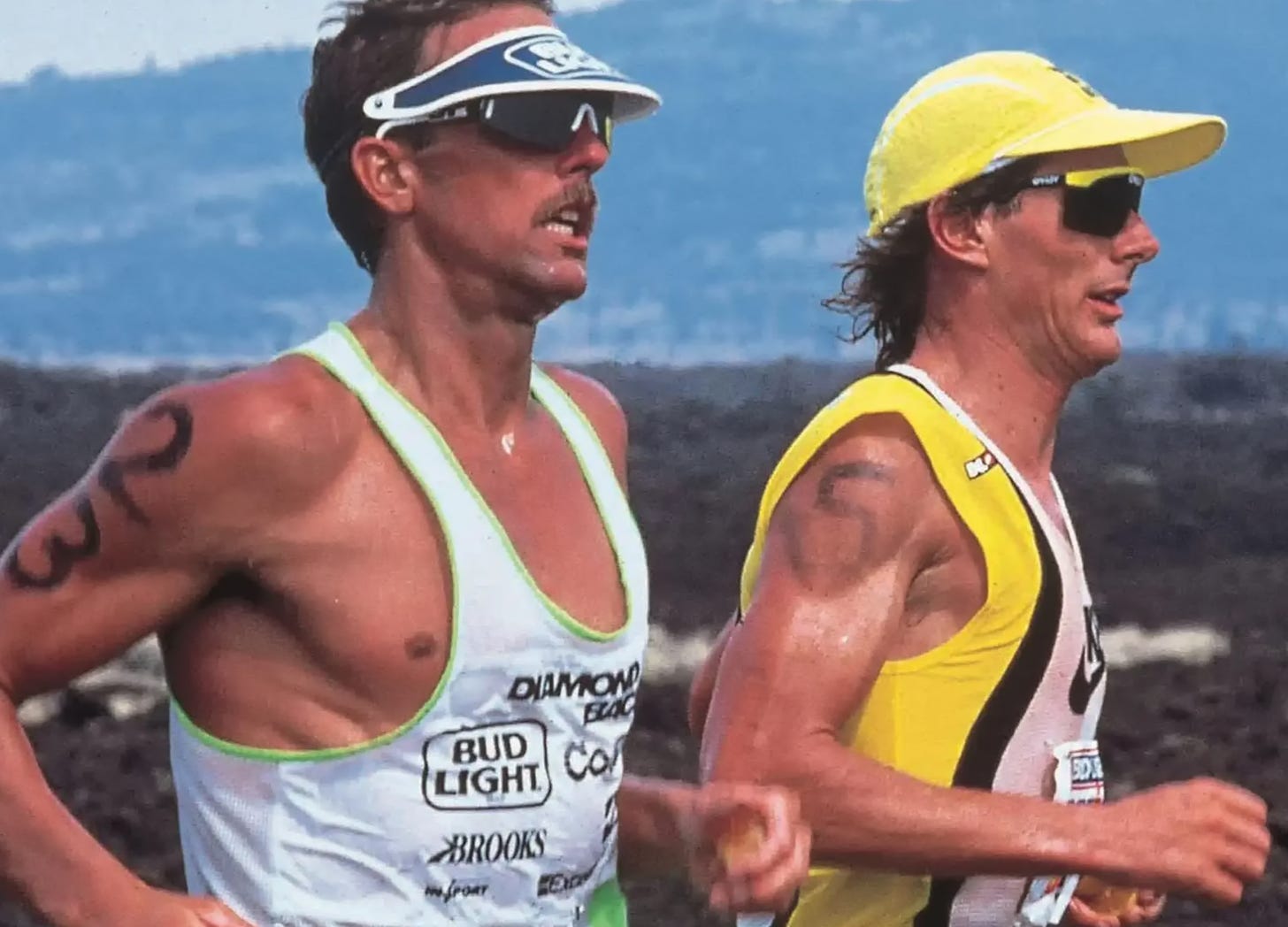
It happened during the 1989 Ironman World Championship in Kona.
Dave Scott and I were locked in an epic battle for the ages. There was no easing off. No chance to regroup. Every footstep felt like it was going to be my last. Every breath mattered. Every glance at Dave told me the same thing.
Neither of us was going anywhere.
Somewhere around mile 10 of the marathon, just as the race was reaching full intensity, another competitor decided he wanted in.
Not Dave.
Not another athlete.
My digestive system.
Without warning, it delivered a message that was impossible to misunderstand.
Now.
Not in five minutes.
Not at the next aid station.
Not after the cameras.
Now.
If you’ve raced long enough, you’ve learned the difference between discomfort and certainty.
This was certainty.
There was absolutely no negotiating with what was about to happen.
Then I looked up the road.
About twenty yards in front of us was the ABC camera truck, filming backward toward Dave and me as we ran shoulder to shoulder. The ABC crew was filming so close I was looking right in their eyes. Behind us stretched a convoy of spectator cars following the leaders of the race. Every windshield was pointed at us. Every camera was rolling. Every pair of eyes was fixed on the two men battling for the Ironman World Championship.
There was nowhere to hide.
No porta-potty.
No bushes.
No shoulder.
No time.
Stopping wasn’t an option. Dave would disappear up the road, and with him might go the race.
Then a tiny voice inside my head said something completely absurd.
“You’ve trained for everything else.”
So I made a decision I hope never appears in any coaching manual.
I stayed in stride.
The next few seconds required a level of concentration I don’t think I’ve ever duplicated.
I hooked my shorts, squatted into a duck walk and then it happened.
Not a polite little inconvenience.
An explosion.
One instant everything was contained. The next instant it was as if my body had decided it had been carrying around far too much unnecessary ballast and was going to jettison all of it immediately.
Right there.
On the yellow center line.
Without breaking stride.
Without changing pace.
Without losing a single step to Dave.
Let’s just say the Queen K acquired a souvenir.
The ABC truck had the perfect angle.
The spectators in the cars behind us had front-row seats.
If anyone happened to glance down instead of watching our faces, they witnessed what may still stand as the greatest moving pit stop in the history of endurance sports.
Thankfully, television directors tend to favor close-ups.
A stride later it was over. Shorts returned to their upright position.
Business concluded.
Race resumed.
I settled right back into rhythm as though absolutely nothing had happened.
Dave never gained a step.
I never lost contact.
It was at that moment that Dave spoke the only word that passed between us the entire race when he looked over at me and said, “Impressive.” Then combat resumed.
I’ve also often wondered what was going through the minds of the cameramen.
Imagine being assigned to film the greatest duel in Ironman history.
You’re perfectly framed.
The leaders are locked together.
The light is perfect.
The drama is building.
And suddenly…
well…
you have a completely different story unfolding in your viewfinder.
I’m fairly certain that footage never made the evening broadcast.
Probably for the best.
People often imagine championship races as being made up entirely of moments of glory.
The truth is they’re filled with moments of humanity.
Cramps.
Blisters.
Vomiting.
Salt crusted across your face.
Bloody feet.
Stomachs that rebel after six or seven hours of racing.
Elite sport isn’t glamorous from the inside.
It’s biological.
Your body doesn’t know it’s on national television.
It doesn’t care that you’re racing for a world championship.
It doesn’t know there are helicopters overhead or an announcer trying to create drama.
It simply continues doing what bodies have done since the beginning of time.
Sometimes inconveniently.
Sometimes spectacularly.
One of the greatest lessons endurance sport teaches is humility.
You can spend months preparing to become the strongest version of yourself.
Then one cramp, one blister, one upset stomach, or one extraordinarily determined colon reminds you who’s really in charge.
Oddly enough, that’s comforting.
Because once you’ve had enough moments like that, your ego starts to loosen its grip.
You stop believing champions are somehow immune from ordinary human problems.
You realize that everyone standing on a starting line is carrying around exactly the same fragile machinery.
The difference isn’t that champions avoid embarrassing moments.
The difference is they keep running anyway.
Years later people ask me about victories.
About pacing.
About nutrition.
About racing Dave Scott.
Sometimes they ask what was going through my mind during those legendary miles on the Queen K.
Usually they expect something profound.
Something about suffering.
Something about destiny.
Something about becoming one with the race.
Sometimes the truth is much simpler.
Sometimes you’re just hoping your body will cooperate for another ten minutes.
And sometimes…
it doesn’t.
Thankfully, endurance athletes become expert improvisers.
We solve problems while moving.
We adapt.
We keep going.
That’s probably the biggest lesson hidden inside this ridiculous story.
Life rarely unfolds under perfect conditions.
Your plans unravel.
Your equipment breaks.
Your stomach rebels.
Your expectations disappear.
The question isn’t whether something unexpected will happen.
It will.
The question is whether you’ll stop because it happened.
Or whether you’ll figure out a way to keep moving forward.
Preferably while leaving as little evidence behind as possible.
I wouldn’t recommend practicing this particular race skill.
In fact, I sincerely hope none of you ever need it.
But if life ever catches you in one of those moments where dignity and determination collide, remember this:
Perfection isn’t what gets you to the finish line.
Adaptation does.
And somewhere, if there really is a Hall of Fame for race-day improvisation, I’d like to think there’s a little bronze plaque that reads:
Mark Allen. Impressive!
I cannot believe I have never heard this mind-blowing (or should I say body-blowing?) detail from your epic battle. Impressive, indeed! And I thought peeing on the bike was hard...
WOW! Just WOW! After 37 years the (truth) finally come out! :-0