
The Ventoux Shuffle
No time to waste

In 1989 I had three big races circled on my calendar.
And when I say big, I mean really big.
The Nice International Triathlon on May 27. The first-ever ITU Olympic Distance World Championship in Avignon, France, on August 6. And the IRONMAN World Championship in Kona on October 14.
Looking back, the schedule was kind of nuts.
Nice was long. Kona was obviously very long. And right in the middle was Avignon, which was all about speed.
The timing was almost too perfect. Avignon came ten weeks after Nice and exactly ten weeks before Kona.
That sounds nice when you look at it on a calendar.
It wasn’t.
Those were three completely different preparations. For Nice and Kona, I needed the kind of fitness that lets you keep going for hours. Avignon required something else. I needed speed, intensity and the ability to race hard from the gun.
So for the ten weeks leading into Avignon, the really long stuff wasn’t the priority. It couldn’t be. I was trying to become faster.
Then Avignon would end and I would have ten weeks to turn myself back into an Ironman athlete.
Ten weeks.
That’s not very long.
Which is how I came up with what was, in retrospect, a fairly questionable idea.
I decided that the day after the World Championship would be the first day of my Kona training.
No recovery.
No sitting around talking about the race.
No big celebration and then easing back into training three or four days later.
Day One.
Was that smart?
No.
But at the time it seemed completely logical.
That’s one of the strange things about being completely focused on a goal. Ideas that would sound ridiculous to a normal person start sounding completely reasonable.
Kona was ten weeks away. I hadn’t been doing the kind of endurance work I knew I would need there. I wanted to remind my body immediately what long felt like.
Mike Pigg was in Avignon too.
Mike was a close friend, a training partner and one of those guys you probably shouldn’t discuss crazy training ideas with because there’s a good chance he’ll say yes.
Somewhere in the conversation, Mont Ventoux came up.
Perfect.
We would ride it the next day.
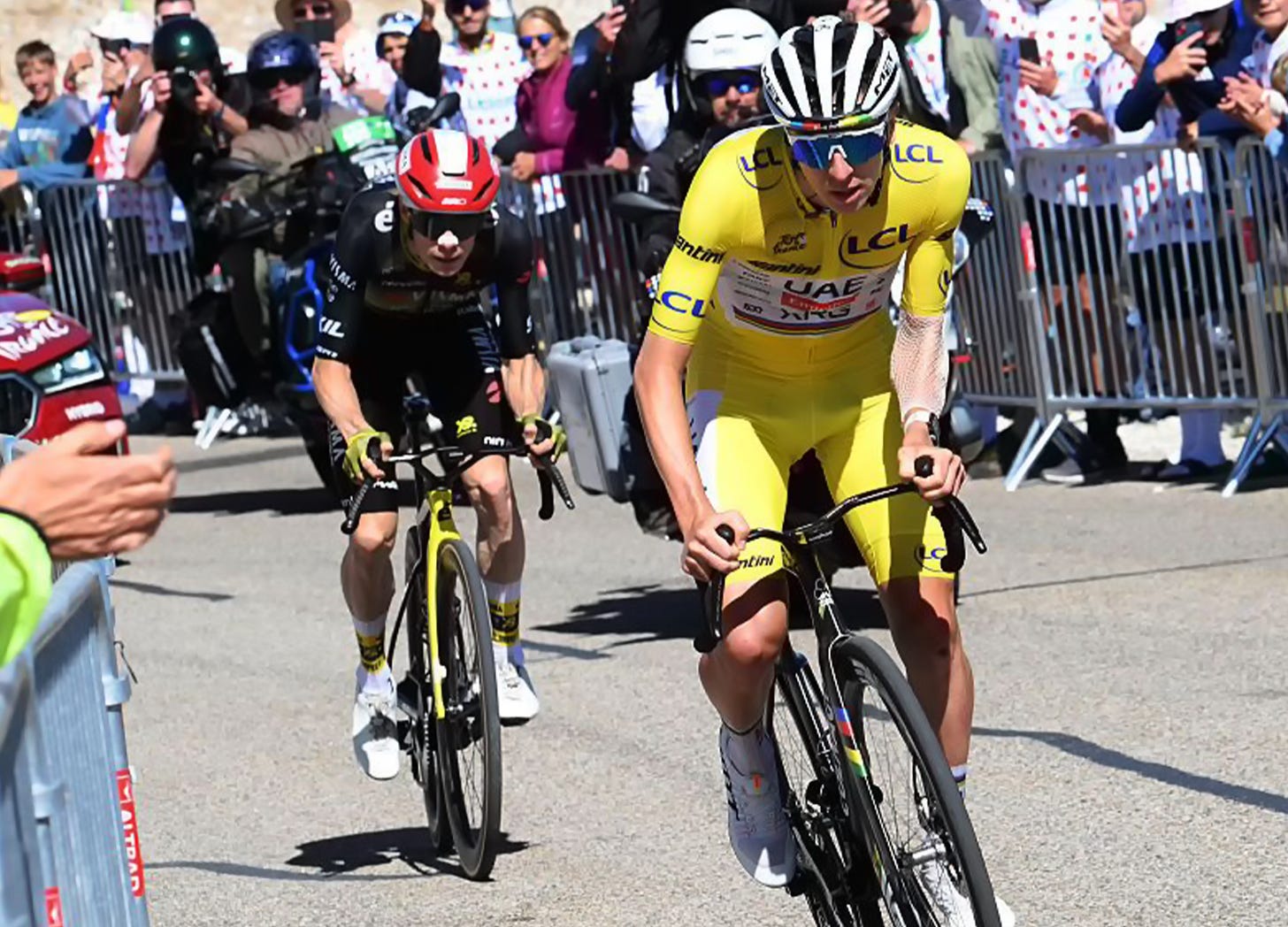
Mont Ventoux is one of the legendary climbs of the Tour de France. From where we were staying in Avignon, the whole ride would be around 90 miles round trip. The climb itself is a little over 21 kilometers with roughly 5,000 feet of elevation gain.
People compare it to Alpe d’Huez. A lot of cyclists will tell you Ventoux is harder.
So naturally we decided to do it the morning after racing the World Championship.
There is a recurring question in this story.
Was this a good idea?
Still no.
We rode out of Avignon and for quite a while everything was fairly pleasant. Relatively flat roads. Beautiful French countryside. Legs turning over.
I don’t remember exactly what Mike and I talked about, but I doubt there was a lot of deep conversation about training theory.
We were just going to ride up this mountain.
Then you get to Ventoux.
And it starts.
There wasn’t much of an introduction. The road just tilted up and suddenly the force required to turn the pedals was completely different.
It was like riding along on a calm day, turning a corner and getting hit with a huge headwind.
Except the headwind doesn’t stop.
One of the main sections goes on for about 16 kilometers at close to a nine percent average grade.
That is a long time to be pushing hard on the pedals.
And that’s when the brilliance of racing a World Championship the day before really started to become apparent.
My legs were dead.
Not tired.
Dead.
There is a difference.
But strangely, the climb became so demanding that after a while I stopped thinking about Avignon altogether.
It didn’t matter what I had done yesterday.
It didn’t matter what my legs were supposed to feel like.
We were on Ventoux and the only way this thing was going to end was if I kept turning the pedals.
So that’s what I did.
We had heard about the upper part of the mountain. Everyone talked about how barren it was. Like riding on the moon.
You hear things like that and create a picture in your mind.
The picture was wrong.
When we came over what looked like the top, there it was.
The actual top.
Way up there.
That was demoralizing.
I remember looking at it and thinking, seriously?
The landscape changes completely. All the beautiful French countryside is spread out thousands of feet below you, and suddenly you’re riding through this barren world of rock and dirt.
There is basically nothing up there that looks inviting to a human being.
And sitting above all of it is the summit.
Farther away than you want it to be.
At that point there wasn’t any strategy left.
There wasn’t any sophisticated thinking about Kona preparation.
There was just this:
Keep pedaling.
That’s one thing I have always loved about endurance sports. Eventually they strip everything away.
Plans are great. Data is useful. Goals matter.
But sooner or later you get reduced to something incredibly simple.
Can you take another step?
Can you turn the pedals one more time?
Yes?
Then do that.
Mike and I eventually made it to the top.
The view was spectacular. You’re standing on this isolated mountain with France stretching out forever below you.
And there was something else there too.
History.
You could feel the Tour de France on that road. You knew how many of the greatest cyclists in the world had suffered on exactly the same pavement.
There were probably ghosts everywhere.
We stood there exhausted, taking it in.
And then came the slightly inconvenient realization that we were only halfway through our ride.
In the Tour, when the stage finishes at the top of Ventoux, you’re done.
We weren’t.
We still had to get back to Avignon.
We descended down the other side, which I remember having pavement that wasn’t maintained nearly as well as the road we’d climbed. By then my whole body was tired. Not just my legs. That deep kind of fatigue where you don’t really want to make any unnecessary movements.
Eventually, late in the afternoon, we rolled back into the parking lot of our hotel.
I was completely cooked.
We had raced a World Championship one day and ridden around 90 miles over Mont Ventoux the next.
Was it textbook training?
Absolutely not.
Would I tell an athlete I’m coaching today that this is the ideal recovery protocol after a World Championship?
Also no.
But I wouldn’t change it.
Because somewhere on that mountain, Avignon ended and Kona began.
That’s what I remember most.
There are moments when you finish one goal and naturally want to stop for a while. Enjoy it. Recover. Look backward.
Sometimes that’s exactly what you should do.
But there are other times when the next thing is already coming toward you.
Kona was coming toward me fast.
Ten weeks.
For most of the season I had been shifting my body back and forth between two different kinds of racing. Nice required endurance. Avignon required speed. Now I needed to become an Ironman athlete again.
Ventoux was the switch.
Not scientifically.
Maybe not intelligently.
But mentally, absolutely.
By the time Mike and I rolled back into that hotel parking lot, there was no question what I was training for anymore.
The World Championship in Avignon had been yesterday.
Kona was next.
And there were zero days to waste.
Wow…incredible. Memories never to be forgotten!
Nice story. Great storytelling!