
Teach Your Children

There are lessons we think we are teaching our children.
Then there are the lessons they are actually learning.
As parents, we spend a lot of time thinking the big moments are the lectures. The carefully chosen words. The advice we give in the car. The things we say at dinner. The reminders about discipline, respect, honesty, commitment, and effort.
But children are not shaped only by what we tell them.
They are shaped by what they see.
They see what we do when we are tired. They see how we handle disappointment. They see whether we keep showing up when no one is applauding. They see whether our word means something. They see whether we make excuses or make adjustments. They see whether we treat people well when we win, and whether we still stand tall when we lose.
They see the code.
And for those of us who have spent our lives in endurance sports, that code is not written on a wall. It is not something framed in a hallway or printed on a T-shirt. It is lived.
Day after day.
Mile after mile.
Workout after workout.
Race after race.
Endurance sports teach a very simple truth: nothing meaningful is built instantly.
You do not become a triathlete because you had one good workout. You do not finish an Ironman because you had one inspired week. You do not become resilient because life was easy. You become those things because you return. You come back after bad days. You train when motivation has left the room. You make peace with discomfort. You learn how to take care of the body, calm the mind, and keep moving toward something that may still be a long way off.
Children absorb that.
Even when they seem like they are not paying attention, they are paying attention.
They see the bike leaning against the wall. They see the wet shoes by the door. They see the early mornings, the quiet breakfasts, the long rides, the ice packs, the stretching, the race numbers, the travel bags, the nervous silence before competition. They see the strange combination of exhaustion and joy that comes from doing something hard and honest.
At first, they may not understand it.
They may just know that Mom or Dad disappears for a run, comes back sweaty, and somehow seems more peaceful. They may know that race day means standing behind barricades, ringing cowbells, looking down the road, and waiting. They may know the smell of sunscreen, wetsuits, chain grease, bananas, and finish-line grass.
But over time, something deeper gets through.
They begin to understand that effort matters.
They begin to understand that hard things can be chosen.
They begin to understand that the body is not just something you look at, but something you inhabit, train, respect, and trust.
They begin to understand that fear is not always a stop sign. Sometimes fear is simply the first gate you pass through on the way to becoming bigger than you were yesterday.
That is the gift endurance sports can give a family.
Not perfection. Not medals. Not trophies.
Values.
The value of preparation.
The value of patience.
The value of humility.
The value of continuing when the mind starts negotiating with the body.
The value of finishing what you started.
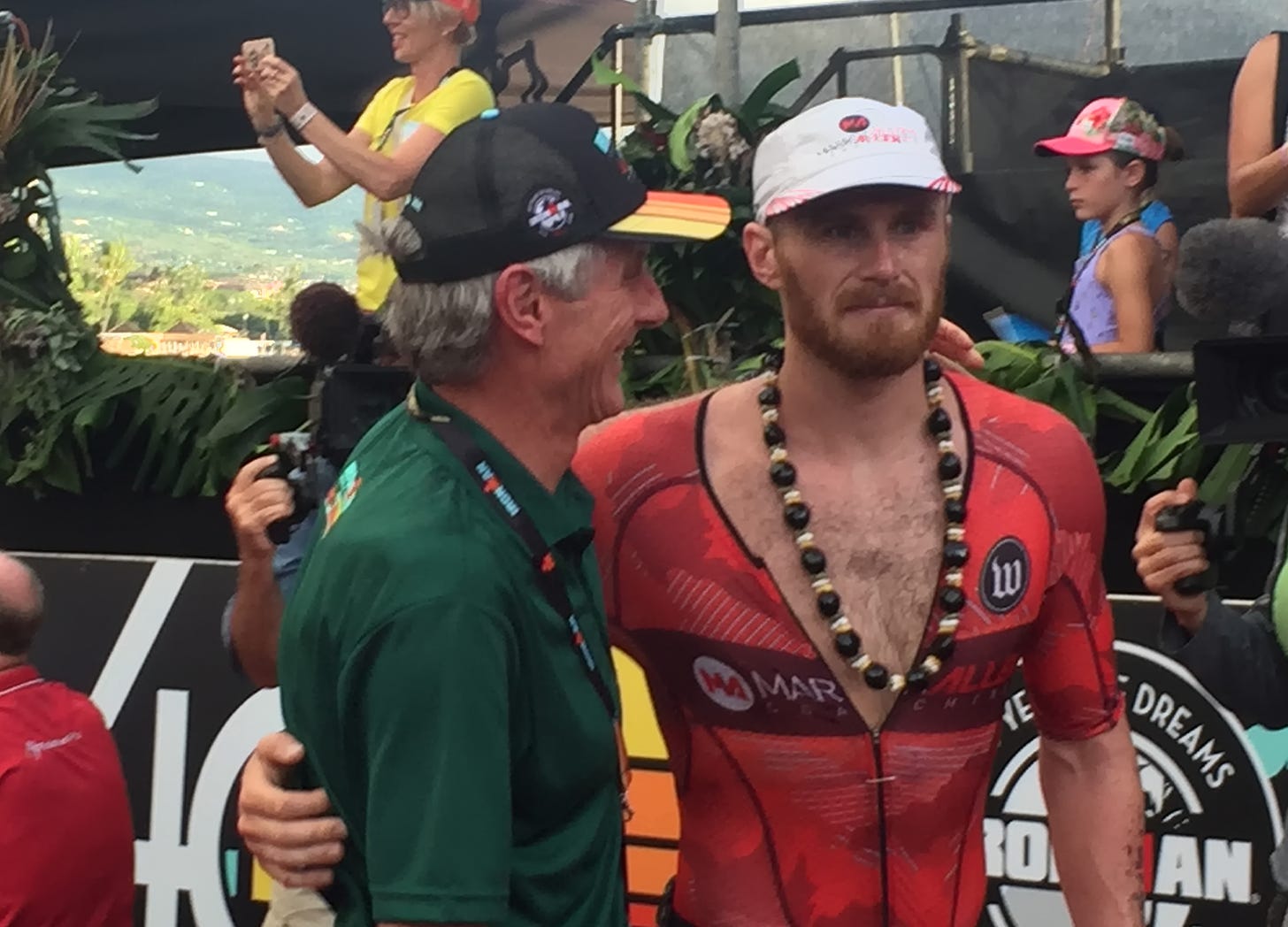
I thought about all of that when my son Mats finished the Ironman.
There are moments in life when time does something strange. It does not move forward. It folds in on itself.
Standing there at the finish line, waiting for him, I was not just watching an athlete complete a race. I was watching a life come full circle.
I could see the little boy he had been. I could see the years, the lessons, the moments he had witnessed without any of us realizing how deeply they were landing. I could see all the ways sport had been present in his life, not as pressure, not as a demand, but as an atmosphere. A language. A way of understanding what it means to meet life with courage.
And then there he was.
Coming down that finish chute.
An Ironman.
There is a particular look people have near the end of an Ironman. It is hard to describe unless you have been there or watched it closely. The body is emptied. The face is stripped of pretense. The performance has become something more honest than performance. It is not about how you look anymore. It is about who you are when there is very little left to hide behind.
That is what I saw in Mats.
I saw effort. I saw grit. I saw vulnerability. I saw pride. I saw the long conversation between doubt and determination that every endurance athlete must eventually have.
Most of all, I saw that the values were intact.
That is what moved me.
Not just that he finished.
That he finished with the spirit of the thing.
He had not just completed a distance. He had carried the code all the way to the line.
There is a deep gratification in that, one that is difficult to explain. As parents, we want our children to be happy, but we also know that happiness alone is not enough to carry a person through life. Life will test them. Life will ask more from them than comfort can provide. Life will give them moments when the road is long, the weather changes, the plan falls apart, and no one can take the next step for them.
In those moments, what will they have?
Hopefully, they will have a memory.
Maybe not a speech. Maybe not a lesson we sat them down to deliver.
Maybe they will remember watching us get up early when we did not feel like it. Maybe they will remember how we treated a competitor. Maybe they will remember us coming home from a bad race disappointed but not broken. Maybe they will remember that we kept going, not because it was easy, but because it mattered.
That is teaching.
That is parenting.
That is legacy.
We sometimes talk about legacy as if it is something large and public. A record. A title. A career. A name that gets remembered.
But the deepest legacy is often much quieter.
It is what your children carry into their own hard moments.
It is the voice inside them that says, “Stay with it.”
It is the instinct to keep moving when things get uncomfortable.
It is the understanding that a finish line is not only a place where a race ends. It is a place where a person discovers what was built long before the race began.
Teach your children.
Teach them by showing them what discipline looks like without turning it into obsession.
Teach them that sport is not punishment. It is a celebration of being alive in a body capable of adapting, enduring, and surprising itself.
Teach them that winning is wonderful, but character is better.
Teach them that strength and kindness can live in the same person.
Teach them that courage does not always roar. Sometimes it is just the decision to keep moving toward the next aid station, the next mile marker, the next breath.
Teach them that failure is not fatal.
Teach them that the real opponent is often the voice that says, “You can’t.”
Teach them that there is dignity in effort, even when no one sees it.
And when the day comes that you stand at a finish line and see your child coming toward you, carrying those lessons in their own body, in their own stride, in their own suffering and triumph, you will understand something very profound.
They were watching.
They were learning.
They were becoming.
And for one beautiful moment, all the early mornings, all the long miles, all the quiet examples, and all the values you hoped would matter will come back to you in the form of a person you love crossing a line they had to reach on their own.
That is full circle.
That is the code.
Teach your children.
Mark, I think you are really onto something here.
The part that lands for me is that children are always learning, but often not from the places we think the teaching is happening. I might even take it a bit farther. I am not sure we can really inculcate values in our children in any direct sense. We can name them, of course. We can talk about them. We can hope they matter. But I think what children mostly absorb is the way we live in our own bodies, our own choices, our own disappointments, our own effort, our own limits.
And that is where parenting becomes a bit counterintuitive.
Some of what can look, from the outside, like selfishness or self-centredness in a parent may actually be one of the deepest forms of teaching. A parent who trains, rests, protects their own energy, pursues something difficult, or refuses to disappear completely into service of everyone else may be showing a child something essential: that caring for yourself is not a betrayal of the people you love. It is part of how you remain whole enough to love them well.
So yes, they are watching. But maybe the real lesson is not just “be disciplined” or “keep going.” Maybe it is also: inhabit your life. Respect your body. Take your own becoming seriously. Do not abandon yourself and call it love.
That may be one of the harder lessons for parents to trust, because it can feel less obviously sacrificial. But I suspect it is one of the lessons children most need.
Keep leading ...
You put into words what we intuitively know but cannot express. Thank you.